At Otherside, we strive to create innovative and compelling game experiences, led by some of the top veterans in the Gaming Industry. We have two projects that are both works in progress, including Argos & Thick as Thieves.
My core responsibilities at Otherside include:
• Operating in a studio-level role in a novel function at OtherSide Entertainment, driving initiatives and plotting out scale on all endeavors related to Game Economics
• Building and establishing the design goals and implementation of progression systems for engagement and retention in future OtherSide Entertainment products
• Establishing definitions related to player profiles and setting player experience goals in the foundational in-game economies, with foundational analytics support to plot out future live KPIs
• Responsible for the in-game economy, monetization, data modeling and analytics, live operations, and predictive product performance for OtherSide Entertainment products
I worked on the core progression systems in Thick as Thieves: Into the Shadows.
The challenge of developing progression in the first chapter of Thick as Thieves revolved around a need to advocate for the core progression while also understanding that resources were limited.
The conclusion I came to with the allocation given was to set up a leveling system, a cosmetic distribution system correlating with the Acts, and converting the in-game currency (Cash) into Cosmetic/Tool/other unlockables.
• Levels
I opted into the level approach as a low-effort method of conveying "engagement" to the player and the capacity to present status to their peers. Due to the game being a "4-8 hour" total experience, I opted into a 25 level system with a flat level curve interval. What that means is that from levels 1-5, players need 500 experience to level. From levels 6-10, players need 1000 experience to level. From levels 11-25, players need 2500 experience to level.
This coincides with the unlock cadence of higher difficulties - "Thief" and "Master Thief". These difficulties give an avenue for players to have increased experience rewards as the experience from each Mission does not go up. These serve as carrots to incentivize players to convert to higher difficulties.
The biggest mistake we ran into in this capacity is clearly communicating this to players, but this occurred due to limited resources.
• Tool Distribution through Acts
Our progression system has unlock paths for both cosmetics and tools - in general, Contracts unlock Tools, which are then required to be purchased from the Black Market. One of the core goals is to ensure having a sufficient sink for the income that the player experiences in the game.
As a result, there were a multitude of items a player was able to unlock in the game from the Contract system, and we optimized the Novice difficulty in-game economy to ensure players had marginally more money than needed to unlock the core unlocks.
The core problem in the design is my perception that players do not like unlocking the ability to purchase an item - it has detrimental affects on the player's feelings of progression.
• In Game Currency
Our game does not have a secondary resource, but instead directly converts Loot into Cash. That Cash value immediately is able to be used by the player.
This was the simplest method to ensure that we could have a valuation system set up in the game, but it has incredibly high inflationary risk in a game-by-game basis. In addition, this caused a performance delta in the cash acquisition - and we didn't establish sufficient enough levers to mitigate that risk due to potential gameplay implications.
Overall, the journey for progression was a bit difficult with limited resources, and we're aspiring for greater heights on the future steps in the project.
•
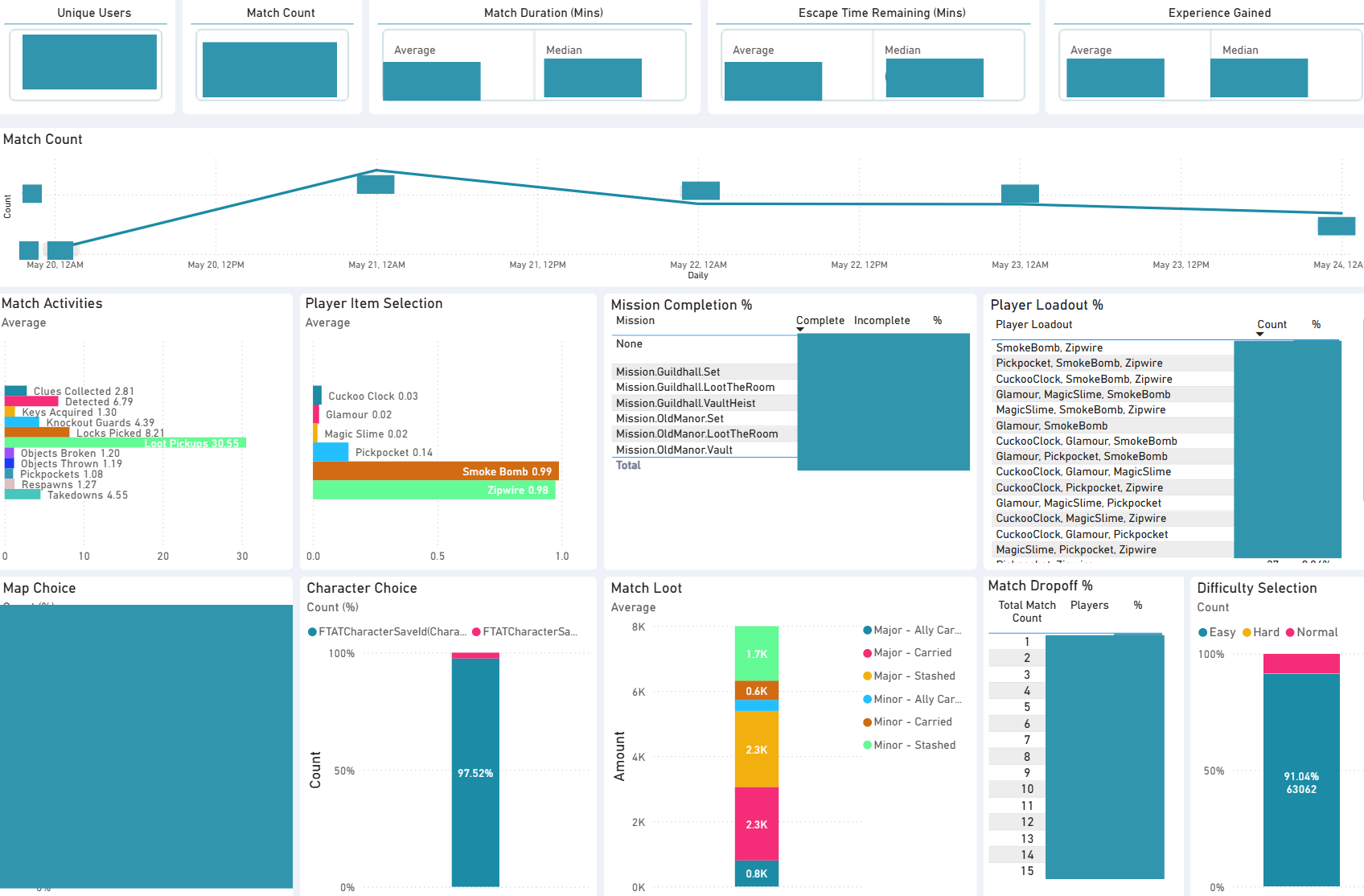
I led the initiative on converting OtherSide into a data-informed studio, plotting out what metrics in-game to measure as well, as well as guiding our Data Engineering support on what types of dashboards we needed.
• My instrumentation strategy focused around establishing player cohorts and determining player behavior through our dashboard strategy.
• After establishing these cohorts, I set up regular reporting towards C Suite and Leadership to showcase player behaviors.
• Using data, I helped guide and inform our Design Team to determine potential Design actionables.
• These insight tools were built completely from scratch using GameAnalytics as a foundation, along with BigQuery. We then worked with Data Engineering support to build integration into Fabric. As such, I am comfortable with building Player Insights and Tooling.
• Dashboards evolved over time with ML support to integrate Heatmaps and other models.